Prices and features verified on ableton.com on October 22, 2026 (US store, USD).
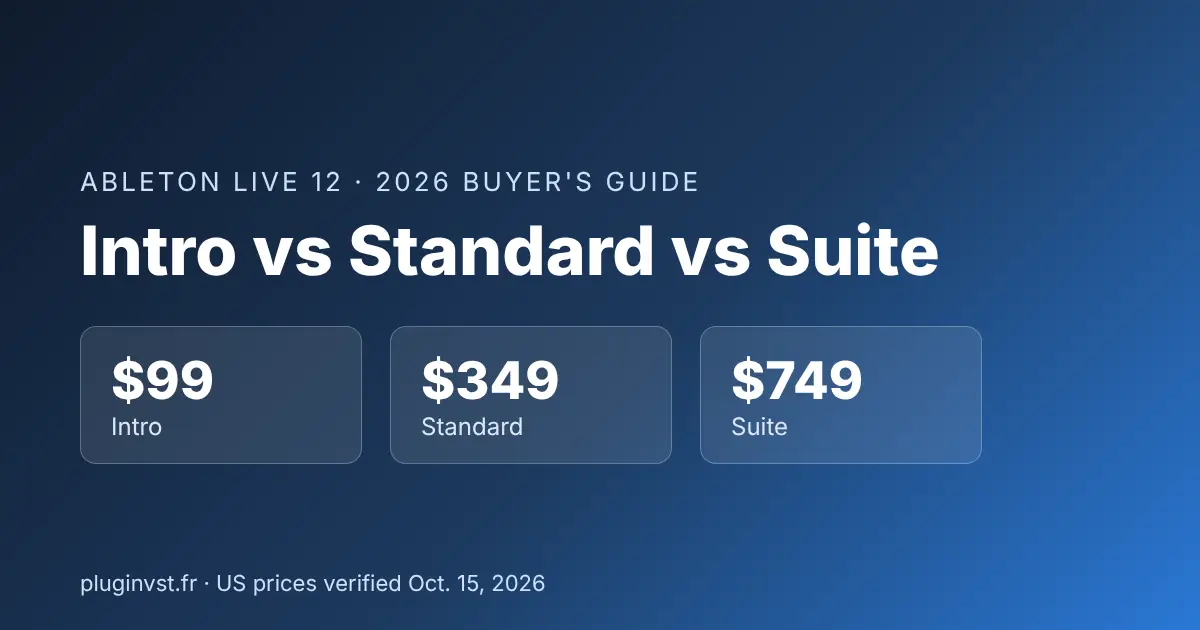
Live 12 costs $99 (Intro), $349 (Standard) or $749 (Suite) (Ableton shop). Ableton’s official comparison page runs to more than a hundred rows. Only a handful of them decide which edition you should buy. This guide pulls those out: each edition’s hard limits, what Suite adds over Standard, whether Ableton can be free, and every official way to pay less.
Key Takeaways
- Intro ($99) caps you at 16 audio/MIDI tracks, 16 scenes and 2 send/return tracks. Fine for learning, tight for finished productions.
- Standard ($349) removes those limits and adds audio-to-MIDI, audio slicing and more instruments, but not Max for Live.
- Suite ($749) adds Max for Live, Suite-only instruments such as Wavetable, Operator and Meld, stem separation, and 71+ GB of sounds.
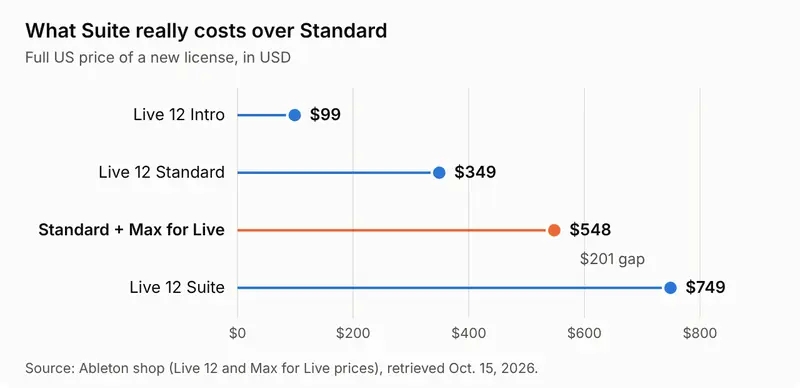
- Standard plus the Max for Live add-on already costs $548, so Suite’s real premium is $201.
- Ableton isn’t free, but you can try Suite free for 30 days, get Live Lite with some hardware, or save 50% with an education license.
Ableton Live 12 prices at a glance (2026)
Live 12 is a one-time license purchase, not a subscription: $99 for Intro, $349 for Standard and $749 for Suite in the US store. Even the monthly “rent-to-own” plan ends with you owning the license. The total is the same as buying outright (Ableton).
| Option | Intro | Standard | Suite |
|---|---|---|---|
| New license (USD) | $99 | $349 | $749 |
| Education license (−50%) | $49 | $174 | $374 |
| Rent-to-own | Not available | Not available | $31.21/mo × 24 months |
| Education rent-to-own | Not available | Not available | $31.17/mo × 12 months |
| Free trial | 30 days of the full Suite edition | ||
Sources: Ableton shop, Ableton education shop, Ableton trial page, retrieved October 22, 2026. Prices outside the US differ.
If you already own an older Live license, you pay a discounted upgrade price instead, which Ableton only shows once you log into your account (Buying Live FAQ).
What’s the difference between Intro, Standard and Suite?
All three editions run the same engine: Session View, warping, unlimited undo and multitrack recording up to 32-bit/192 kHz. What changes is how far you can scale a project and which instruments, effects and sounds come in the box. The rows below, from Ableton’s comparison chart, are the ones that change what you can do in a project.
| Feature | Intro | Standard | Suite |
|---|---|---|---|
| Price (new license) | $99 | $349 | $749 |
| Audio & MIDI tracks | 16 | Unlimited | Unlimited |
| Scenes | 16 | Unlimited | Unlimited |
| Send/return tracks | 2 | 12 | 12 |
| Audio inputs / outputs | 8 / 8 | 256 / 256 | 256 / 256 |
| Audio-to-MIDI, audio slicing, linked-track editing | No | Yes | Yes |
| Max for Live | No | Paid add-on | Included |
| Stem separation (Live 12.3+) | No | No | Yes |
| MIDI effects | 12 | 13 | 14 |
| Packs | 4 | 16 | 33 |
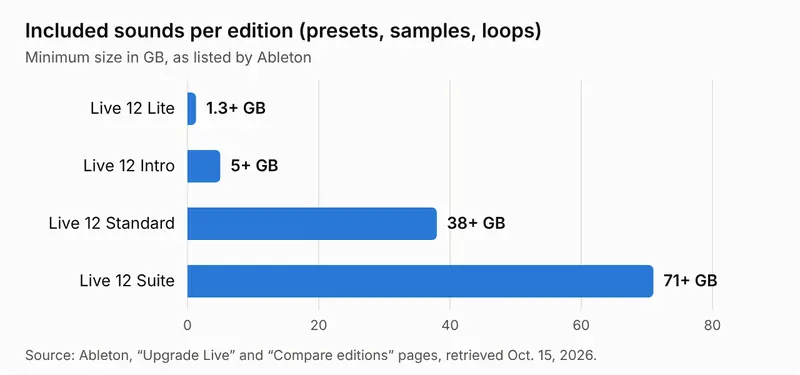
| Presets, samples & loops | 5+ GB | 38+ GB | 71+ GB |
Source: Ableton, Compare Live editions, retrieved October 22, 2026.
A note on instrument and audio-effect counts: Ableton’s pages don’t agree with each other. The comparison page summarizes 8, 12 and 21 instruments, while its shop and upgrade pages list 8, 13 and 20, and audio-effect totals vary in the same way. Intro’s audio inputs and outputs differ too: 8 on the comparison page, 16 on the upgrade page. Rather than repeat a number that may be wrong, this guide names the instruments each edition adds, which you can check yourself.
Live 12 Intro: who it’s for, and the 16-track wall
Intro is the cheapest full version of Live and works for learning, sketching ideas and small projects. Its 16-track and 2-send limits are the first ones you’ll hit. A drum kit split across separate tracks, a bass, a few synth layers and a vocal can fill 16 tracks quickly. And with two send/return tracks, you get one reverb and one delay. There’s no room left for parallel processing.
Intro still includes the core instruments, among them Simpler, Drift, Drum Rack, Drum Sampler and Impulse, plus 4 Packs and 5+ GB of sounds (Ableton). There’s no audio-to-MIDI conversion and no audio slicing. Live 12’s Modulation feature is reserved for Standard and Suite.
Moving up later costs money. Upgrading from Intro to Standard or Suite is a paid upgrade (Ableton Live Upgrade FAQ). It’s discounted from the full price, and your exact amount appears in your Ableton account.
Verdict: buy Intro if you’re testing whether Ableton suits you after the trial, or if your projects stay small.
Live 12 Standard: no track limits, no Max for Live
Standard removes every project-size limit (unlimited tracks and scenes, 12 sends, 256 inputs and outputs) and adds editing tools Intro doesn’t have. That includes audio-to-MIDI, audio slicing, linked-track editing, REX file support and Live 12’s modulation devices (Ableton).
Standard adds five instruments on top of Intro: Drum Synths (a set of 8 synthesized drum devices), Analog, Collision, Electric and Tension. It also brings 12 more Packs, including Grand Piano, Orchestral Strings, Electric Keyboards and two Session Drums libraries, for 38+ GB of content in total.
What Standard doesn’t have: Max for Live, the seven Suite-only instruments, and stem separation. If you mostly work with third-party plugins, those gaps may never matter. Ableton sells Max for Live separately as an add-on for Standard owners (Ableton Help).
Live 12 Suite: what the extra $400 buys
Suite costs $400 more than Standard, but if you’d buy Max for Live anyway, the real difference is $201. Max for Live is a $199 add-on for Standard (Ableton shop), so Standard plus Max for Live comes to $548, against $749 for Suite.
Those $201 buy you three things:
- Seven Suite-only instruments: Wavetable, Operator, Meld, Sampler, Granulator III, Poli and Bass.
- Stem separation, added in Live 12.3 and available only in Suite. It separates a mixed audio file into individual stems inside Live.
- 17 more Packs and roughly 33 GB more sounds (33 Packs and 71+ GB against 16 and 38+ GB), including orchestral brass, woodwinds and mallets, the Spitfire-made string quartet, brass quartet and upright piano, and Ableton’s Sequencer and MIDI Tools Packs (Ableton).
Counted per gigabyte of included sounds, Intro works out to roughly $19.80 per GB, Standard about $9.20 and Suite about $10.55. Ableton lists minimum sizes (“5+ GB”), so these are upper bounds. Per gigabyte, Suite costs about the same as Standard.
Verdict: Suite is worth it if you want Max for Live, or you’d otherwise buy extra synths and sample libraries. If you build your sound from third-party plugins, Standard plus your own tools is the leaner choice.
Is Ableton free? Every legitimate way to use it without paying
Ableton Live isn’t free. There are four ways to use it without paying, and each has a catch.
1. The 30-day Suite trial
The trial unlocks every Suite feature for 30 days. Ableton says no credit card is required (Ableton trial). When it ends, you can still open Live Sets made during the trial. You just can’t save or export them anymore. To keep working, you buy any edition: Intro, Standard or Suite.
2. Live 12 Lite, bundled with hardware
Live Lite comes free with many hardware products and some apps, including Ableton Note. The license never expires, and it isn’t sold on its own (Ableton Live Lite). It’s the most limited edition: 8 audio/MIDI tracks, 16 scenes, 2 sends, 2 Packs and 1.3+ GB of sounds (Ableton upgrade page). If you own an older Lite version, the upgrade to Live 12 Lite is free.
3. Free Intro licenses for schools and youth programs
Schools, charities and youth clubs teaching music to students mostly under 19 can apply for free Live 12 Intro licenses. They get a multi-seat license for up to 60 computers, plus two single-user licenses for teachers. Colleges, universities and vocational courses are excluded. Verification can take up to 10 working days (Ableton Classroom).
4. Cracked copies
Pirated versions break Ableton’s license terms and can carry malware. With a free trial and a $49 education price available, they aren’t worth the risk.
How to pay less for Ableton Live 12
The biggest official saving is the education discount, which halves the price of any edition. Rent-to-own spreads Suite’s cost over time with no surcharge.
Education discount: 50% off
Students and teachers pay $49 for Intro, $174 for Standard or $374 for Suite (Ableton education shop). You’re eligible if you are:
- a full-time student aged 18 or over;
- a parent or guardian buying for a student under 18;
- a part-time student in a program of 20+ hours a week or lasting 12+ months;
- a teacher at a school or university (part-time and private teachers need 20+ hours a week).
You upload a student or teacher ID, and verification usually takes one business day. The discount applies only to new licenses, not to upgrades (Ableton Help). A student Suite license ($374) costs only $25 more than a full-price Standard ($349).
Rent-to-own Suite
Rent-to-own gives you Suite immediately for $31.21 a month over 24 months. There’s no interest, mark-up or late fee, and the license is yours once the plan is paid off (Ableton). Upgrade plans from Lite, Intro or Standard to Suite run 8 to 21 months, depending on your current license. The education version costs $31.17 a month over 12 months.
Max for Live crossgrade
If you own Live Standard and the standalone Max software, you can add Max for Live for $99 instead of $199 (Ableton shop).
Ableton promo codes and sales
Ableton’s webshop accepts coupons. Its FAQ notes that third-party coupons can come with their own terms (Buying Live FAQ). We didn’t find a public promo code on Ableton’s own pages. Be wary of “promo code” sites promising large discounts. Some retailers run time-limited sales. If you’re not in a hurry, compare their price with Ableton’s own store before you buy.
Which Ableton Live 12 edition should you buy?
Start with the free trial. Then choose by how big your projects get and how much you rely on Ableton’s own instruments.
- Complete beginner: use the 30-day trial first. If a MIDI controller you buy includes Lite, start there; otherwise Intro ($99) is a low-risk first purchase.
- Producer finishing full tracks with third-party plugins: Standard ($349). Unlimited tracks, 12 sends and audio-to-MIDI remove Intro’s limits.
- Sound designer or Max for Live user: Suite ($749). Once you’d buy Max for Live anyway, the gap shrinks to $201.
- Student or teacher: the $374 education Suite is the best value of the lineup, as long as you qualify.
- Tight monthly budget: Suite rent-to-own at $31.21 a month, at no extra total cost.
If you’re still deciding between Ableton and another DAW, start with our DAW guides.
Verdict: category winners
| Category | Winner |
|---|---|
| Lowest entry price | Intro ($99) |
| Project size (tracks, scenes, sends) | Standard = Suite |
| Editing tools (audio-to-MIDI, slicing) | Standard = Suite |
| Instruments, Packs & sounds | Suite |
| Max for Live & stem separation | Suite |
| Best value for most producers | Standard |
| Best value overall, if you qualify | Suite education ($374) |
Frequently asked questions
Is Ableton Live a subscription?
No. You buy a license once. Ableton’s rent-to-own plan spreads the payment over 12 to 24 months, but the total equals the regular price and you keep the license at the end.
How long is the Ableton Live free trial?
30 days, with every Suite feature unlocked. After that you can open your projects but not save or export them until you buy an edition.
Can I upgrade from Intro to Suite later?
Yes. Upgrades between editions are paid but discounted from full price, and your upgrade price appears in your Ableton account. The education discount doesn’t apply to upgrades.
Does Ableton have a student discount?
Yes, 50% off new licenses for eligible students and teachers: $49 (Intro), $174 (Standard) or $374 (Suite) in the US store.
Is Live Lite enough for beginners?
For first steps, yes, but its 8-track limit is tight. Lite is a free bonus with compatible hardware; if you outgrow it, you’re eligible for upgrade pricing to a higher edition.
The easiest next step is to download the free trial from Ableton’s site and note which Suite-only devices you actually use in those 30 days.
